
Seville is one of those cities that reveals itself slowly. At first, you notice the sunshine, orange trees, tiled courtyards and busy tapas bars. Then you look a little closer and begin to see something else: arches that feel familiar, geometric brickwork, Arabic-inspired decoration, old defensive towers and gardens built around water and shade. For Muslim travelers, this second layer of Seville is often the most fascinating, because beneath modern Sevilla lies the story of Ishbiliya, one of the great cities of al-Andalus.
Muslims ruled Seville for more than five centuries, and the city became particularly important under the Almohads in the 12th and 13th centuries. Their influence can still be seen in some of Seville’s most famous landmarks, including the Giralda, parts of the Alcázar, the old city walls and the Torre del Oro. What makes exploring Islamic Seville especially interesting is that its history is not contained inside one perfectly preserved monument. Instead, it appears in layers. A minaret became a bell tower, a mosque courtyard became part of a cathedral, and Muslim palaces were later adapted by Christian kings. Walking through Seville is therefore less like visiting a museum and more like piecing together a historical puzzle.
This route is easy to do on foot and takes you through the heart of the old city. If you enjoy history, photography and taking your time, allow at least half a day. You could easily stretch it into a full day by adding the Macarena walls, stopping for lunch and taking a proper break for salah.
Start at the Giralda: Seville’s Famous Former Minaret
The best place to begin is the Giralda, one of Seville’s most recognisable landmarks. Today, it rises above Seville Cathedral as a bell tower, but its story began very differently. The lower section of the Giralda was originally built as the minaret of Seville’s Great Mosque during the Almohad period in the 12th century. Standing beneath it, it is worth trying to mentally remove the enormous cathedral beside you and imagine the area as it would have looked during Muslim rule, with the minaret rising above a vast mosque complex at the centre of Ishbiliya.
Look closely at the tower and the Islamic influence becomes much easier to see. The patterned brickwork, repeating arches and geometric decoration are unmistakably Almohad. If you have travelled in Morocco, you may notice similarities with the Kutubiyya Mosque in Marrakesh. Both belong to the same wider architectural tradition, and seeing those connections is one of the things that makes Andalusia so interesting for Muslim travelers. The history of al-Andalus was never isolated from North Africa; people, ideas, architecture and scholarship moved between the two sides of the Mediterranean.
Climbing the Giralda is also much more enjoyable than climbing an ordinary bell tower because most of the way up is made through ramps rather than a narrow staircase. The climb is still tiring, especially in warm weather, but the views make it worth the effort. As you rise above the old city, you get a sense of just how important this tower must once have been. From the top, Seville spreads out around you in every direction. It is a good moment to imagine the medieval city below, filled with markets, mosques, workshops, palaces and homes.
The Patio de los Naranjos: A Piece of the Old Mosque
After coming down from the Giralda, do not rush away from the cathedral complex. Spend some time in the Patio de los Naranjos, or Courtyard of the Orange Trees. This peaceful courtyard is one of the surviving parts of the former Great Mosque and is an important reminder that the Giralda did not stand alone. It belonged to a much larger religious complex. The courtyard feels very Andalusian today, with orange trees, water and plenty of shade, but its layout also gives you a glimpse of how mosque courtyards were designed.
During the Muslim period, this area formed part of the mosque and was connected with preparation before prayer. Even though much of the original building is gone, the combination of trees, water and open space still creates a sense of calm in the middle of a very busy part of Seville.
For Muslim travelers, this can be one of the more reflective stops on the route. It is easy to imagine worshippers entering the mosque hundreds of years ago, gathering in the courtyard and preparing for salah. At the same time, it is important to remember that the site is now part of an active cathedral complex. Its Islamic history is significant, but it should be visited respectfully as the religious space it is today.
Cross to the Real Alcázar
From the cathedral, it is only a short walk across to the Real Alcázar of Seville, one of the most beautiful and historically complicated buildings in the city. Many visitors arrive expecting a purely Islamic palace, but the Alcázar tells a much more layered story. Its origins go back to the Muslim period, when rulers created and expanded a fortified palace complex in this part of the city. The Almohads later developed it further, and some elements from that period still survive.
After Seville was conquered by Castile in 1248, the palace remained important. Christian rulers continued to use it and added new sections over the centuries. What is especially interesting is that they did not simply replace Islamic artistic traditions. In many cases, they continued using them. Muslim craftsmen and Islamic-inspired decorative styles remained highly valued, which is why some of the most “Islamic-looking” rooms in the Alcázar were actually built after Muslim rule had ended.
This style is often called Mudéjar, and understanding that makes the Alcázar much more interesting. Rather than seeing the palace as simply Muslim or Christian, it is better to see it as a place where different periods of Seville’s history overlap. Islamic architecture, Christian royal power and later artistic traditions all sit beside one another.
Slow Down Inside the Alcázar
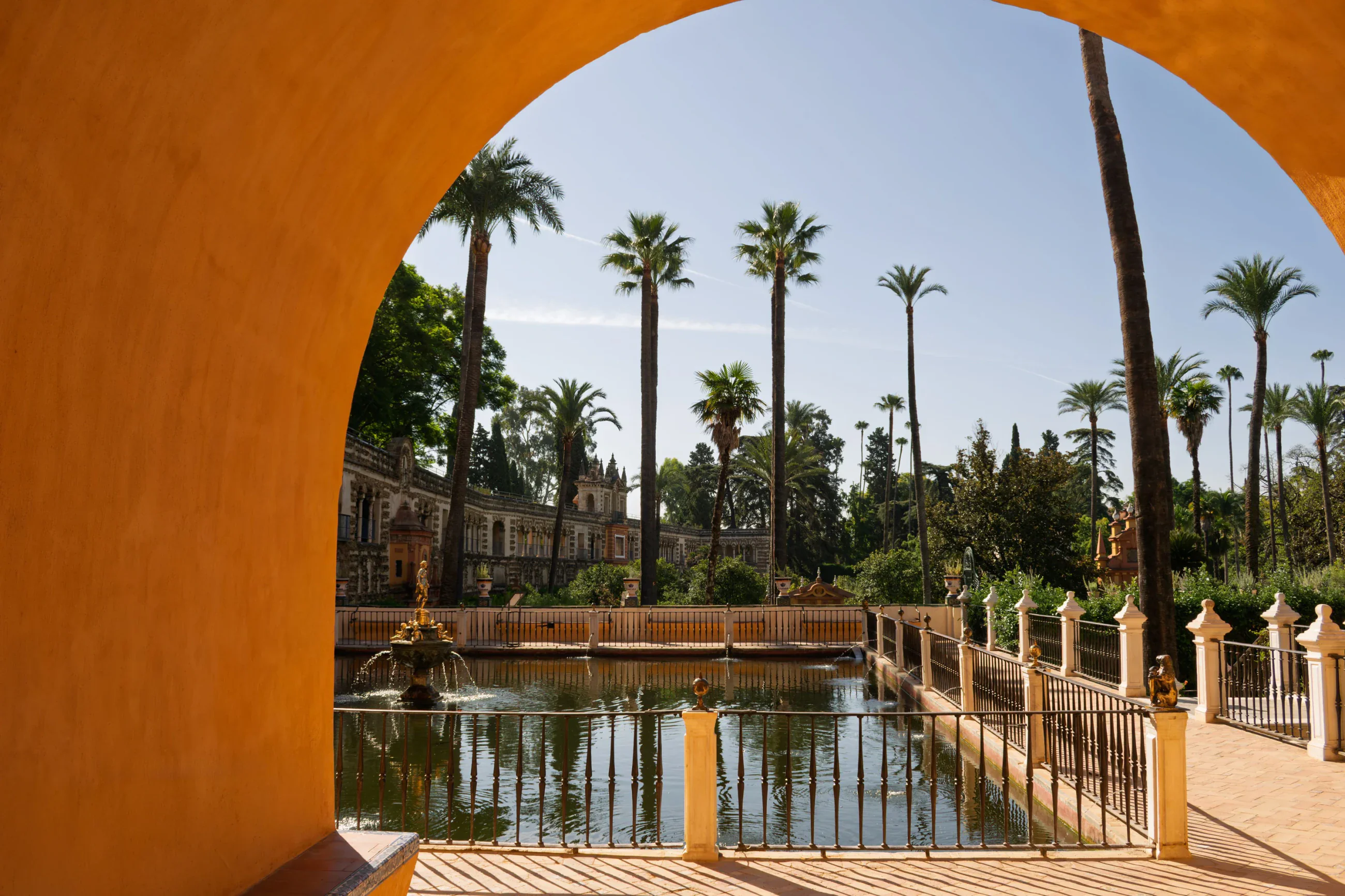
The Alcázar is the kind of place where it is very easy to walk around taking hundreds of photos and then realise you have barely looked at anything properly. Slow down and pay attention to a few recurring features instead. Water is everywhere, appearing in pools, fountains and channels that cool the courtyards and gardens. Geometry covers walls and ceilings in repeated patterns, while arches frame views from one room into another. You will also notice Arabic calligraphy in different parts of the palace.
The Arabic decoration is especially interesting because not all of it dates from Muslim rule. Some inscriptions and Islamic-style decorative elements were commissioned by later Christian rulers. That alone tells you how powerful and prestigious the artistic language of al-Andalus remained after the political situation had changed.
The gardens are also worth exploring properly. They are large, green and much quieter than some of the palace rooms. Water again plays a major role, and the mix of fountains, trees and shaded paths makes it easy to understand why gardens were such an important part of palace life in southern Spain. Give yourself at least an hour and a half here, although two hours is better if you genuinely enjoy architecture and history.
Look for the Almohad City Beyond the Big Monuments
Once you leave the Alcázar, it can be tempting to head straight into Santa Cruz for lunch or coffee. That is not a bad idea, but if you want to understand Islamic Seville properly, continue towards the remains of the old Almohad defensive system. The Giralda and Alcázar are impressive, but they were only part of a much larger Muslim city. The Almohads surrounded Seville with extensive walls, gates and towers. Some of those structures disappeared as the city expanded, but several traces still survive.
One of the easiest to miss is the Torre de Abdel Aziz, near the historic centre. It does not attract crowds like the Giralda, yet it is one of those small places that suddenly makes the city’s history feel more real. Continue towards the Torre de la Plata, another surviving part of Seville’s medieval fortifications.
These smaller towers are worth seeing because they help you understand Ishbiliya as a functioning city rather than simply a collection of beautiful palaces. Medieval Seville needed walls, defensive routes and controlled entrances just like any other major city of the period. When you start connecting the Giralda, Alcázar and old towers together, the layout of the Almohad city becomes easier to imagine.
Finish at the Torre del Oro and the Guadalquivir
From the old fortifications, continue towards the river until you reach the Torre del Oro, one of the best places to finish your walking route. The Almohads built the tower in the early 13th century as part of Seville’s defensive system. Its position beside the Guadalquivir was extremely important because the river connected the city with trade routes, other parts of al-Andalus and the wider Mediterranean world.
Today, the riverside is peaceful and popular with walkers, cyclists and visitors taking photos, but during the medieval period this was a strategically important part of the city. Standing here helps you understand why Seville became so powerful. It was not only a political and cultural centre; it was also a city closely connected to movement, commerce and the river.
This is also a good place to stop and rest after several hours of walking. Grab a drink, sit by the Guadalquivir and look back towards the old city. By this point, the Giralda should feel very different from when you first saw it. It is no longer simply Seville’s famous bell tower. You now understand it as part of a much larger Almohad city that once stretched from the Great Mosque and palace complex to the defensive towers along the river.
Prayer in Seville for Muslim Travelers
Seville has an active Muslim community, so finding somewhere to pray is possible with a little planning. One convenient option is the Fundación Mezquita de Sevilla, which is reasonably close to the historic centre and hosts daily prayers and Jumu'ah. Another option is Mezquita Al-Hidaya, in the Macarena area. If you are planning your day around salah, check current prayer times and mosque access before setting out, especially on Fridays, during Ramadan or around Eid.
It is also worth keeping in mind that the Giralda and Patio de los Naranjos may have Islamic origins, but they are now part of the cathedral complex and should not be treated as present-day Muslim prayer spaces. A simple way to organise the day is to explore the cathedral area and Alcázar in the morning, stop for lunch and prayer, and then continue towards the old Almohad towers and river in the afternoon.
If You Have More Time: Walk the Macarena Walls
If you want to see even more of Islamic Seville, head north towards the Macarena walls. This area contains one of the best-preserved stretches of Seville’s medieval defensive walls and gives a much clearer impression of the scale of the old fortified city. The Macarena section is less polished and less dramatic than the Alcázar, but that is part of its appeal. You are not standing inside a royal palace surrounded by tourists. You are walking beside actual city defences that helped protect medieval Ishbiliya.
If you enjoy imagining what places looked like centuries ago, this is one of the best spots in Seville to do it. Walking alongside the wall, you can picture travelers approaching the city gates, merchants arriving with goods and guards watching the roads outside the city. Modern traffic makes the scene slightly less cinematic, but a little imagination helps.
Why Islamic Seville Is Worth Exploring
What makes Islamic Seville so interesting is that its history has not survived in one neat, untouched form. Instead, it has been reused, adapted and built over for centuries. The Giralda became a bell tower. The Great Mosque was replaced by a cathedral, while its courtyard and minaret survived. Muslim palaces became residences for Christian kings. Arabic decoration continued to be used even after Islamic rule ended, and Almohad towers became part of the modern street plan.
For Muslim travelers, that can make Seville a particularly meaningful city to explore. You are not simply visiting old monuments; you are seeing evidence of how deeply Muslim civilisation shaped the architecture, culture and identity of southern Spain. Some traces are obvious, while others require you to look more carefully.
That is the real pleasure of walking through Islamic Seville. By the end of the day, the city starts to look different. The Giralda is no longer just a famous tower. The Alcázar is no longer simply a beautiful palace. The old walls are no longer random pieces of stone beside busy roads. Together, they reveal the outline of Ishbiliya, the Muslim city that still exists beneath modern Seville.
Planning Seville? Explore our Muslim travel guide to Seville. →
Exploring more of southern Spain? See our halal travel guide to Andalusia. →