
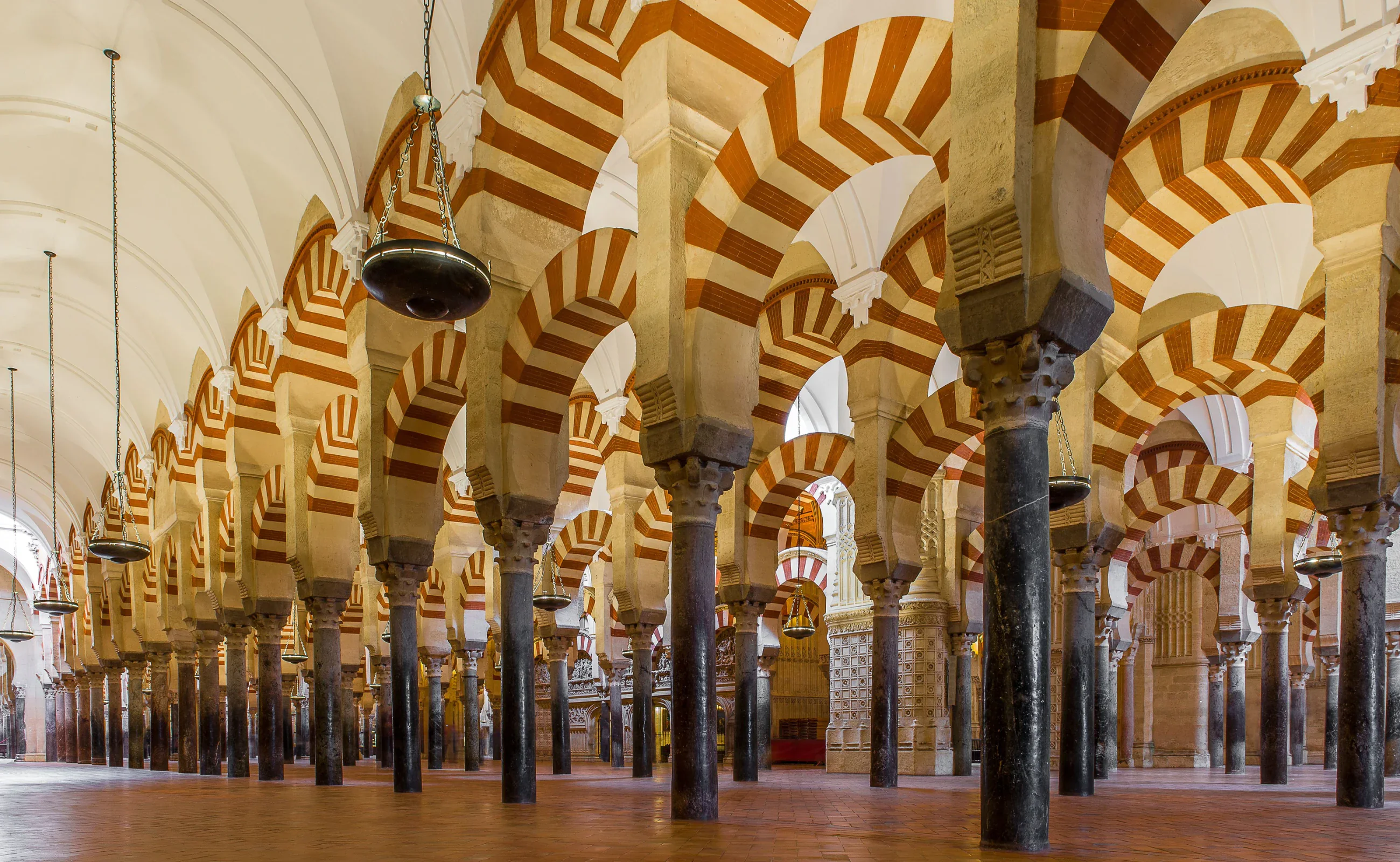
There are some buildings you visit because they are famous, and others that stop you in your tracks the moment you walk inside. The Great Mosque of Córdoba is one of those places. You step through the entrance, your eyes adjust to the softer light, and suddenly hundreds of red-and-white arches stretch out in every direction. Columns disappear into the distance, creating the feeling of a stone forest. For Muslim travelers, visiting Córdoba can be especially meaningful.
This was once Qurtuba, capital of the Umayyad Caliphate and one of the most important cities in al-Andalus. The Great Mosque stood at the centre of that world, growing over generations as Córdoba itself became larger, richer and more powerful. What makes the mosque so fascinating is that you can still read that history in the building. The arches, columns, courtyard, mihrab and later cathedral additions all tell part of the story.
Before You Enter: Meet Qurtuba
Muslim rule began in Iberia in the early eighth century, and Córdoba quickly became one of the most important cities in al-Andalus. In 756, Abd al-Rahman I, a survivor of the Umayyad dynasty, established his rule in Córdoba after fleeing political upheaval in the eastern Islamic world. A few decades later, he began building the Great Mosque. The mosque was expanded several times by later rulers, including Abd al-Rahman II, Abd al-Rahman III, al-Hakam II and al-Mansur. That is why the building feels so large and layered. It was not created all at once. It grew with the city. By the tenth century, Córdoba had become the capital of a powerful caliphate and an important centre of government, learning, craftsmanship and culture.
Start in the Courtyard of the Orange Trees
Before entering the prayer hall, spend a few minutes in the Patio de los Naranjos, or Courtyard of the Orange Trees. During the Muslim period, this formed part of the mosque complex and was connected with ablution before prayer. The courtyard changed over the centuries, but it still gives you a sense of the relationship between open space, water and the prayer hall. It is worth stopping here before heading inside. Imagine worshippers arriving for Jumu'ah, performing wudu and then entering the mosque together. Then walk through the doors. This is where Córdoba becomes unforgettable.
The Famous Red-and-White Arches
The first thing you notice is the arches. Rows of red-and-white arches seem to continue endlessly through the building, creating one of the most recognisable interiors in Islamic architecture. The mosque’s builders reused columns and capitals from older Roman and Visigothic structures. Many of those columns were too short for the height they wanted, so they created an ingenious solution: two levels of arches. The result was practical, but also beautiful. Once the initial “wow” moment passes, slow down and look more carefully.
The columns are not all the same. Their materials, colours and details vary because many came from earlier buildings. Move around the prayer hall and the view constantly changes. Columns line up, arches frame other arches and patches of light appear between darker sections. This is one place where wandering without a strict plan is actually a very good idea.
The Mosque Kept Growing
The Great Mosque expanded several times as Córdoba grew. Abd al-Rahman II extended the prayer hall, Abd al-Rahman III enlarged the courtyard and built a new minaret, and al-Hakam II added some of the most spectacular parts of the building. You do not need to memorise every expansion before visiting. Instead, simply notice how the architecture changes as you walk. Some sections are simple and repetitive. Others become richer, more decorative and more elaborate. Eventually, you reach the most impressive area of all.
The Mihrab
The mihrab is one part of the mosque you should not rush past. In a mosque, the mihrab marks the qibla wall and indicates the direction of prayer. Córdoba’s mihrab is particularly striking, surrounded by gold mosaics, Arabic calligraphy and detailed vegetal designs. Nearby, the arches become more complex and the ceilings more decorative. This area was created during the reign of Caliph al-Hakam II, when Córdoba was at the height of its power and wealth. Take a moment here without your phone.
Look at the calligraphy. Look at the patterns. Look up at the ribbed domes. For Muslim visitors, it is also worth remembering what this part of the building once represented. This was the most important end of the congregational mosque, close to where the imam led the prayer.
Then You Walk Into a Cathedral
One of the strangest parts of visiting the Great Mosque comes when you suddenly find yourself standing inside a Renaissance cathedral. Córdoba was conquered by Ferdinand III of Castile in 1236, after which the mosque was converted into a Catholic cathedral. Christian chapels were added over time, and in the sixteenth century a large cathedral nave and choir were built inside the former mosque. The contrast is dramatic. One moment you are surrounded by low red-and-white arches, and the next you are looking up at huge Christian vaults and a cathedral choir. Then you turn around, and the Islamic arches appear again. Few buildings show different periods of history sitting so visibly beside one another.
The Minaret Is Still There
Outside, the bell tower also hides part of the building’s Islamic past. Abd al-Rahman III built a minaret here in the tenth century. Although the tower was later transformed into the Christian bell tower you see today, parts of the original minaret survive inside it. It is another reminder of how Islamic Córdoba was not always completely destroyed or removed. In many cases, later buildings were constructed around, over or inside what already existed.
Can Muslims Pray Inside?
Today, the Great Mosque of Córdoba is an active Catholic cathedral as well as a historic monument. Muslim visitors can visit and appreciate its Islamic history, but it should not be treated as a current mosque or prayer space. If you need to pray while visiting Córdoba, there are active Muslim prayer spaces elsewhere in the city. It is worth checking current access and prayer times before your visit, especially for Jumu'ah or during Ramadan. Planning your prayer stop separately makes the day much easier and allows you to visit the Mosque-Cathedral respectfully while still keeping salah in your schedule.
Do Not Leave Córdoba After Seeing Only the Mosque
If you have more time, visit Madinat al-Zahra, the ruined palace-city outside Córdoba built by Abd al-Rahman III. It gives you a much better picture of the world that surrounded the Great Mosque during the height of the Umayyad Caliphate. The mosque shows you the religious heart of Qurtuba, while Madinat al-Zahra gives you a glimpse of its royal and political life. Even if you cannot fit it in, take your time inside the mosque itself. This is not a place to rush through just because you have ten more Córdoba attractions saved on your phone.
A History You Can Read
The Great Mosque of Córdoba becomes much more interesting once you stop seeing it as simply one beautiful building. The reused columns tell you about earlier Roman and Visigothic Córdoba. The double arches show the creativity of its Muslim builders. The expansions tell the story of a growing and increasingly powerful city. The mihrab reflects the wealth of the Umayyad caliphate, while the cathedral in the centre tells the story of what came later. For Muslim travelers, that history can make the visit especially powerful.
You are standing beneath arches that were built more than a thousand years ago for a Muslim community that once gathered there for prayer. You may arrive because you want to see the famous red-and-white arches. But once you understand what they represent, they become much more than a beautiful background. They become a history you can read.
Planning Córdoba? Explore our Muslim travel guide to Córdoba. →
Exploring more of southern Spain? See our halal travel guide to Andalusia. →