
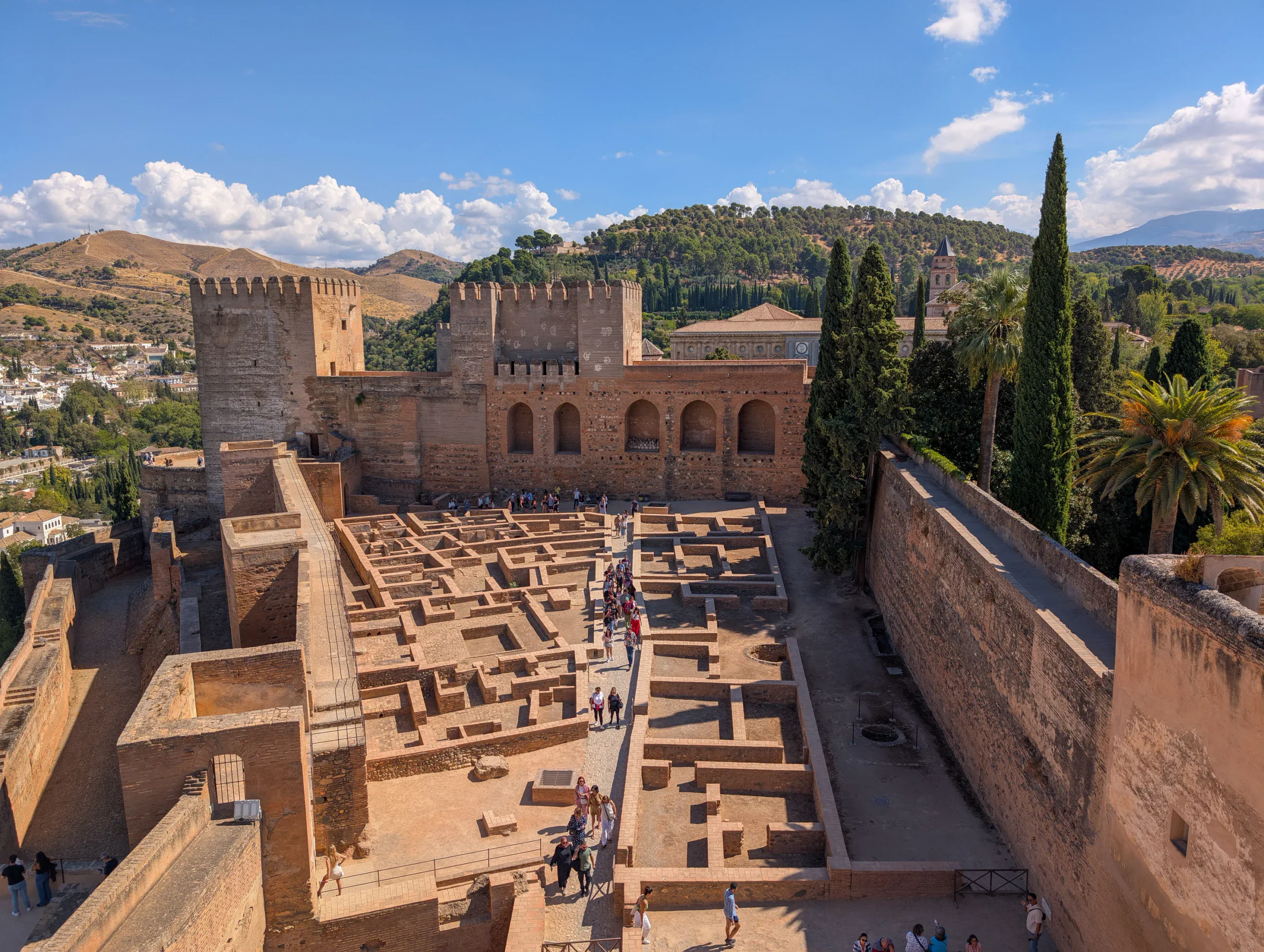
The Alhambra is one of those places that looks impressive in photos and still manages to surprise you in person. From a distance, it seems like a huge fortress above Granada. Once you step inside, the mood changes completely. Thick defensive walls give way to delicate arches, Arabic calligraphy, carved plaster, quiet courtyards and pools that reflect entire palace façades. For Muslim travelers, the Alhambra is one of the most important places to visit in Spain.
It was the royal palace and fortress of the Nasrid dynasty, the last Muslim rulers of al-Andalus. For more than two centuries, this hilltop complex was the political and ceremonial heart of the Emirate of Granada. What makes the Alhambra so special is not only its history. It is the detail. Qur'anic verses, poetry, geometric patterns, flowing water and hidden Arabic phrases appear throughout the palaces. The more carefully you look, the more the Alhambra reveals.
First, What Exactly Is the Alhambra?
The Alhambra is not one palace. It is an entire fortified complex containing royal residences, defensive towers, gardens, courtyards and the remains of a small city. Its name comes from the Arabic al-Qal'a al-Hamra, usually translated as “the Red Fortress.” Although earlier fortifications existed here, most of the Alhambra we recognise today was developed under the Nasrid dynasty from the 13th century onwards. Muhammad I, founder of the Nasrid dynasty, established his royal residence here after taking control of Granada in 1238. Later rulers continued expanding and decorating the complex, turning it into both a seat of government and a symbol of Nasrid power.
Start With the Alcazaba
Before entering the elegant palaces, it helps to remember that the Alhambra was also a fortress. The Alcazaba is the oldest surviving part of the complex. Its thick walls, defensive towers and narrow passages feel completely different from the peaceful courtyards you will see later. Climb towards the Torre de la Vela and look across Granada. From here, you immediately understand why the Nasrids chose this position. The views stretch across the city and towards the surrounding mountains. Try to imagine guards watching the roads below. You will probably still take the panoramic photo.
The Nasrid Palaces
The most famous part of the Alhambra is the Nasrid Palaces. Much of what you see today was created during the 14th century, especially under rulers such as Yusuf I and Muhammad V. At first, the decoration can feel overwhelming. Almost every surface is covered with something: carved plaster, geometric tiles, woodwork, Arabic inscriptions or plant designs. But the decoration is not random. Water reflects the architecture. Arches frame carefully planned views. Calligraphy becomes part of the walls. Light changes the appearance of rooms throughout the day. The palace was designed to make you slow down.
Look for the Arabic on the Walls
One of the most interesting things to do inside the Alhambra is to stop seeing the walls as decoration and start seeing them as text. Arabic inscriptions appear throughout the Nasrid Palaces. One phrase is repeated again and again: Wa la ghaliba illa Allah — “There is no victor except Allah.” This was the motto of the Nasrid dynasty. Once you recognise it, you start noticing it everywhere. The walls also contain poetry, religious phrases and praise for rulers. In some rooms, the writing is so closely woven into the decoration that it is difficult to tell where the pattern ends and the text begins. For Muslim travelers, recognising the Arabic can make the palace feel much more personal.
The Court of the Myrtles
The Court of the Myrtles is one of the calmest spaces in the Alhambra. A long rectangular pool runs through the middle, bordered by myrtle bushes, with the Comares Tower rising at one end. The pool is not simply decorative. Its still surface reflects the surrounding architecture and makes the palace appear almost doubled in the water. Water plays an important role throughout the Alhambra. It cools the courtyards, creates sound, reflects light and brings movement into otherwise still spaces. Sometimes the most memorable detail is simply hearing it.
The Court of the Lions
The Court of the Lions is probably the most famous part of the Alhambra. At its centre is a fountain supported by twelve stone lions, surrounded by elegant columns and covered walkways. Narrow water channels lead away from the fountain towards nearby rooms. The courtyard feels light and delicate, especially compared with the fortress outside. The slim columns make parts of the architecture appear almost weightless. The lions are also one of the Alhambra's more curious details. Figurative art is not always what visitors expect to find in an Islamic palace, but animal imagery was never completely absent from Islamic artistic traditions.
Look Up
One of the easiest mistakes to make at the Alhambra is forgetting to look above you. Rooms such as the Hall of the Two Sisters contain spectacular muqarnas ceilings made from thousands of small plaster forms. They are sometimes compared to stalactites or honeycomb. As sunlight moves across them, the ceiling seems to change throughout the day. This is one of the Alhambra's great tricks. The materials are often relatively simple, but the craftsmanship makes them look incredibly rich and complex.
The Alhambra Was Built Around Water
The Alhambra sits high above Granada, which makes its fountains and gardens even more impressive. The Nasrids developed a sophisticated water system that brought water from the Darro River to the hill. It supplied the palaces, gardens, fountains and people living inside the complex. Once the water arrived, it became part of the architecture. You see it in pools and fountains, but you also hear it moving through small channels in courtyards and floors. It looks effortless. It definitely was not.
Do Not Skip the Generalife
Many visitors focus so much on the Nasrid Palaces that they rush through the Generalife. Do not. The Generalife was a retreat used by the Nasrid rulers away from the more formal palace complex. Its gardens are filled with water channels, fountains, plants and views back towards the Alhambra. The gardens have changed over the centuries, but the relationship between water, greenery and architecture is still central to the experience. After the busy palace rooms, the Generalife can feel like a deep breath.
What Happened After 1492?
The Nasrid kingdom came to an end in 1492, when Muhammad XII, often known as Boabdil, surrendered Granada to the Catholic Monarchs, Isabella I of Castile and Ferdinand II of Aragon. The Alhambra then became a Christian royal residence. Some Islamic spaces were preserved, while others were altered. Later, Emperor Charles V built a large Renaissance palace inside the complex. The contrast is obvious. After walking through delicate Nasrid courtyards covered in Arabic calligraphy, the Palace of Charles V feels much heavier and more European. That difference is part of the Alhambra's story.
Hidden Details to Look For
The best parts of the Alhambra are often easy to miss. Look closely and you will notice that much of what appears to be carved stone is actually plaster. Look down and you will see colourful geometric tiles. Look around doorways and arches and you will spot Arabic writing woven into the decoration. It is also worth remembering that the Alhambra was once much more colourful. Areas that now appear pale were originally decorated with stronger reds, blues and gold. The palace would have looked far brighter during the Nasrid period.
Can Muslims Pray Inside the Alhambra?
The Alhambra is not a functioning mosque today, so Muslim travelers should plan salah separately rather than expecting to pray inside the Nasrid Palaces. Granada has active Muslim prayer spaces, including mosques around the historic Albaicín area. It is worth checking current prayer times and access before your visit, especially for Jumu'ah. This is useful anyway because an Alhambra visit can easily take several hours.
Take Your Time
The biggest mistake you can make at the Alhambra is rushing. Do not simply photograph the Court of the Lions and move on. Watch how water runs beside your feet. Look for the Nasrid motto on the walls. Notice how sunlight changes the plasterwork. Look through an arch and see how carefully it frames the garden or the city beyond. The Alhambra was designed to be experienced slowly. For Muslim travelers, that can make the visit especially memorable.
You are walking through the palace of the last Muslim dynasty to rule in Iberia, surrounded by Arabic words, Islamic geometry and spaces created more than six centuries ago. Most visitors arrive knowing about the famous courtyards. But the real Alhambra is found in the smaller details: a line of Arabic above a doorway, a perfect reflection in a pool, a ceiling that seems impossible and water quietly moving through the palace. The closer you look, the more it tells you.
Planning Granada? Explore our Muslim travel guide to Granada. →
Exploring more of southern Spain? See our halal travel guide to Andalusia. →